Web Development & SEO • 12 min read
Core Web Vitals 2026: Speed & Performance Guide
Core Web Vitals directly affect your Google ranking — a poor LCP or CLS score pushes you below competitors with slower sites. This complete 2026 guide shows how to improve LCP under 2.5s, eliminate CLS, and increase conversions by 30%+ through performance fixes.
intro
Introduction: Page Speed is a Ranking Factor & Conversion Driver
In 2026, page speed is non-negotiable. Google made Core Web Vitals an official ranking factor in 2021, and it's become increasingly important.
The Stats:
• 0.1 second delay decreases conversion rate by 7%
• 1 second delay causes 7% loss in conversions
• 53% of users abandon pages that take > 3 seconds
• Every 1 second improvement increases conversions by 7-10%
• Ecommerce sites lose $4.7 billion in annual sales to slow performance
Core Web Vitals Impact:
• Sites with good Core Web Vitals convert 24% better than poor ones
• Mobile page speed is crucial (70% of users on mobile)
• Performance now directly affects search rankings
This guide covers everything you need to know about Core Web Vitals and how to optimize for them.
what are cwv
What are Core Web Vitals?
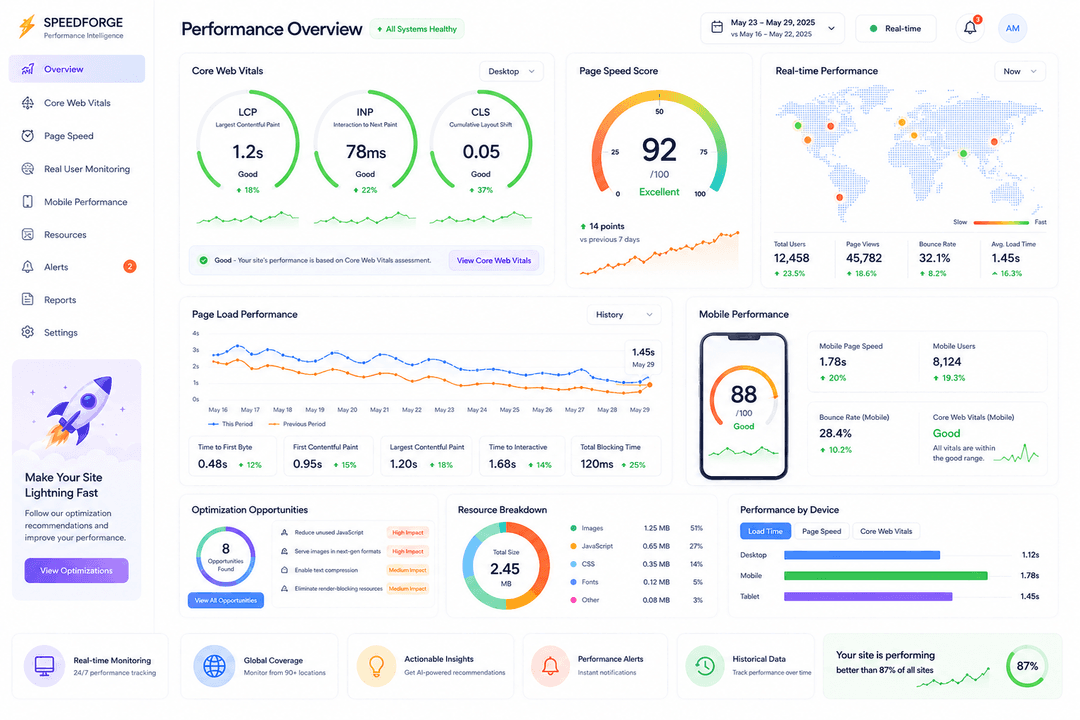
Core Web Vitals are three metrics Google uses to measure user experience:
measure
How to Measure Core Web Vitals
Tools for Measuring:
improve lcp
How to Improve Largest Contentful Paint (LCP)
LCP is what users perceive as 'page load time'. Target: < 2.5 seconds.
Common LCP Issues:
• Slow server response
• Large images
• Render-blocking CSS/JavaScript
• Slow font loading
Optimization Strategies:
1. Optimize Images (Usually #1 Issue)
Impact: Often 40-50% of page weight
Steps:
• Use modern formats (WebP instead of PNG/JPG)
• Compress aggressively (use TinyPNG, ImageOptim)
• Serve different sizes for different devices
• Use lazy loading (load off-screen images later)
• Use CDN for fast global delivery
Example Impact:
• Unoptimized images: 8 seconds LCP
• After optimization: 2 seconds LCP
2. Minimize Render-Blocking Resources
CSS and JavaScript can block rendering.
Solutions:
• Move non-critical CSS below the fold
• Defer non-critical JavaScript
• Inline critical CSS
• Remove unused CSS (PurgeCSS)
3. Optimize Fonts
Fonts can block text rendering.
Solutions:
• Use system fonts (fastest)
• Use font-display: swap (show fallback immediately)
• Reduce font variations (fewer weights)
• Use WOFF2 format (best compression)
• Preload critical fonts
4. Improve Server Response
Slow server = slow LCP.
Solutions:
• Upgrade hosting
• Use CDN (Cloudflare, AWS CloudFront)
• Optimize database queries
• Cache content
• Use caching headers
5. Enable Browser Caching
Allow browser to cache assets.
Set cache headers:
Cache-Control: max-age=31536000
// Cache for 1 year
6. Code Splitting
Load only needed code initially.
Example (React):
const Dashboard = React.lazy(() => import('./Dashboard'));
// Dashboard code only loads when user visits page
improve fid
How to Improve First Input Delay (FID)
FID measures how responsive page feels. Target: < 100ms.
improve cls
How to Improve Cumulative Layout Shift (CLS)
CLS measures visual stability. Target: < 0.1.
implementation plan
Core Web Vitals Optimization Implementation Plan
Phase 1: Measure (Week 1)
• Test homepage in PageSpeed Insights
• Check Search Console for Core Web Vitals data
• Identify main issues (LCP, FID, or CLS)
• Run Chrome DevTools Lighthouse
Phase 2: Quick Wins (Week 2-3)
These give biggest improvements fast:
• Image optimization (compress, modern formats)
• Remove unused CSS/JavaScript
• Enable caching headers
• Lazy load images
Expected improvement: 20-40% faster
Phase 3: Deep Optimization (Week 4-6)
• Code splitting
• Remove render-blocking resources
• Optimize server response
• Setup CDN
• Minify and compress all assets
Expected improvement: 30-60% faster
Phase 4: Fine-Tuning (Week 7-8)
• Third-party script optimization
• Web Workers for heavy processing
• Font optimization
• Reserve space for all dynamic content
Phase 5: Monitor & Maintain (Ongoing)
• Monitor Core Web Vitals weekly
• Track performance trends
• Update optimizations as needed
• Test on real devices/networks
Expected Results:
• Good Core Web Vitals (all green)
• 20-30% faster load times
• 7-15% increase in conversions
• Better SEO rankings
performance seo conversions
How Performance Improvements Increase Conversions
The Conversion Impact Chain:
conclusion
Conclusion: Core Web Vitals are Essential
Core Web Vitals are essential in 2026. They impact:
• SEO rankings
Frequently Asked Questions
What's the most important Core Web Vital?
All three matter, but LCP (page load time) has biggest user impact. Start there if you can only optimize one.
How long does it take to improve Core Web Vitals?
Quick wins: 2-3 weeks. Full optimization: 2-3 months. You'll see improvement immediately after each optimization.
Will Core Web Vitals improvements help my SEO?
Yes. Google uses Core Web Vitals as a ranking factor. Better metrics = better rankings (especially for mobile).
Do Core Web Vitals affect all websites equally?
They matter more for competitive keywords. If you have no competition, Core Web Vitals matter less. But they always improve user experience.
Ready to Improve Your Core Web Vitals?
Our performance experts will optimize your site for Core Web Vitals and increase conversions. Let's make your site fast.
Get Performance Audit