SEO & Digital Marketing • 14 min read
Answer Engine Optimization (AEO) 2026
Learn Answer Engine Optimization (AEO) — how to rank in AI-powered search, voice queries, and generative search beyond traditional keyword SEO.
intro
Introduction: SEO is Dead, Long Live AEO
Search is changing. In 2026, traditional SEO is no longer enough.
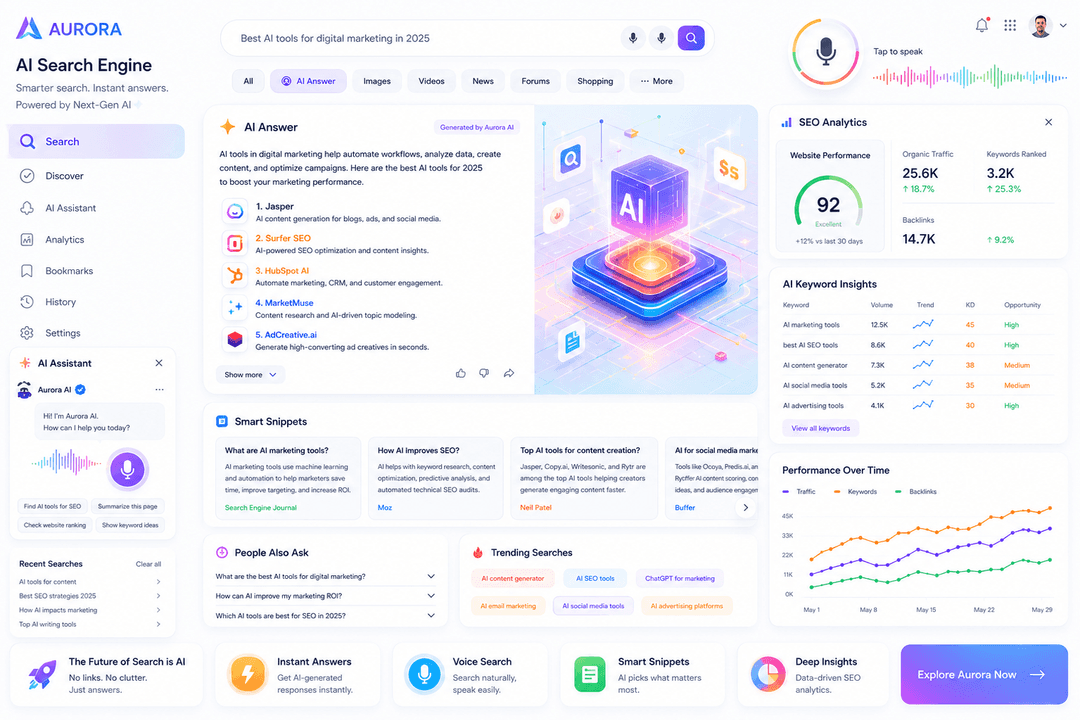
For decades, SEO focused on ranking #1 on Google by optimizing for keywords and backlinks. But search engines are evolving into AI-powered answer engines that provide direct answers, summaries, and recommendations without users needing to click.
This shift introduces a new discipline: Answer Engine Optimization (AEO).
AEO is fundamentally different from traditional SEO:
• Traditional SEO: Rank your page on search results page
• AEO: Get your content cited in AI-generated answers
If you're still optimizing only for keywords and rankings, you're missing the biggest shift in search behavior since Google launched. This guide explains AEO and how to implement it in 2026.
what is aeo
What is Answer Engine Optimization (AEO)?
Answer Engine Optimization is the process of optimizing your content so that AI systems—not traditional search engines—can easily understand, extract, and cite your information in AI-generated answers.
why aeo matters
Why AEO Matters More Than Traditional SEO in 2026
The Search Landscape is Shifting
• 50%+ of searches are now conversational voice searches
how ai evaluates
How AI Systems Evaluate & Extract Content
To optimize for AEO, you need to understand how AI reads and evaluates content:
aeo strategies
8 Actionable AEO Strategies for 2026
Strategy 1: Optimize for Question-Based Queries
AI search is heavily question-based. Optimize for this:
• Create a dedicated FAQ section answering 20-50 common questions
• Write headers as questions: 'How does X work?' 'What is X?'
• Answer questions directly and completely in your content
• Use natural language matching how users actually ask questions
• Include 'People Also Ask' keywords in your content
Strategy 2: Implement Structured Data (Schema Markup)
Schema markup helps AI understand your content:
Implement schema for:
• Organization (company name, logo, contact info)
• Articles (headline, author, date, content)
• FAQs (question-answer pairs)
• Products (name, price, rating, availability)
• Reviews (rating, author, publication date)
• Events (name, date, location)
• Local Business (address, phone, hours)
AI systems parse schema to extract key information. Well-structured schema dramatically improves AEO rankings.
Strategy 3: Create Comprehensive Topic Clusters
Instead of single blog posts, create comprehensive topic clusters:
Example: If your main topic is 'Running Shoes':
• Hub article: 'The Complete Guide to Running Shoes' (5000+ words)
• Cluster: 'Best Running Shoes for Flat Feet'
• Cluster: 'How to Choose Running Shoes'
• Cluster: 'Running Shoe Comparison: Nike vs Adidas'
• Cluster: 'Running Shoe Reviews'
• Cluster: 'Common Running Shoe Problems & Solutions'
AI systems value comprehensive coverage of topics. Clustering helps AI understand you've covered a topic thoroughly.
Strategy 4: Strengthen E-E-A-T Signals
Make your expertise obvious:
• Create an 'About the Author' section with credentials
• Link to your LinkedIn, professional certifications
• Include author bylines on all content
• Get mentioned on industry websites and publications
• Build backlinks from authoritative sites
• Share original research and data
• Display trust signals (awards, certifications, client logos)
Strategy 5: Create Comparison & Listicle Content
AI loves content that synthesizes and compares:
• 'X vs Y' comparisons (highly extractable)
• 'Top 10 [Things]' lists with explanations
• Pros and cons analyses
• Feature comparison tables
This content is easily broken down and cited by AI.
Strategy 6: Optimize for Semantic Search
Use related terms and synonyms naturally:
Poor: Write about 'running shoes' only
Good: Mention 'athletic footwear,' 'jogging shoes,' 'sneakers,' 'trainers,' 'sports shoes' naturally
Use LSI (Latent Semantic Indexing) keywords naturally throughout your content. AI understands synonyms and related concepts.
Strategy 7: Build Citation Authority
Be cited as a source:
• Create original research (studies, surveys, data)
• Share unique insights competitors don't have
• Publish in industry publications
• Get quoted by journalists (media mentions)
• Host expert interviews
When other sites cite your research and insights, AI recognizes your authority.
Strategy 8: Create AI-Friendly Content Formats
Certain formats are easier for AI to extract:
Definition Lists:
Question: What is X?
Answer: X is defined as...
Step-by-Step Guides:
Step 1: Do this
Step 2: Then do this
Step 3: Finally do this
Data & Statistics:
Include percentages, numbers, and facts that AI can extract
Tables & Comparisons:
Side-by-side comparisons are highly extractable
Definitions & Concepts:
Define key terms clearly in 1-2 sentences
voice search
Optimizing for Voice Search & Conversational AI
Voice search optimization is a critical part of AEO:
implementation
Implementing AEO: Step-by-Step Action Plan
Phase 1: Audit Your Current Content (Week 1-2)
• Analyze current top-performing pages
tools
AEO Tools & Resources
Content Optimization:
• Clearscope - Content optimization for semantic search
common mistakes
Common AEO Mistakes to Avoid
Mistake 1: Ignoring Traditional SEO
Don't abandon traditional SEO for AEO. Both are important in 2026. Your website still needs good on-page SEO, backlinks, and page authority.
Mistake 2: Over-Optimizing for AI at the Expense of Users
Write for humans first, AI second. If content is awkward for humans, AI won't rank it well either.
Mistake 3: Not Including E-E-A-T Signals
AI heavily weights authoritativeness. If you don't show expertise clearly, AI won't cite you.
Mistake 4: Poor Content Structure
Walls of text are hard for both humans and AI to extract from. Use headers, lists, tables, and clear sections.
Mistake 5: Ignoring Schema Markup
Schema is one of the easiest wins for AEO. Don't skip it.
Mistake 6: Trying to Game AI Systems
AI systems are sophisticated and detect keyword stuffing, unnatural language, and attempts to manipulate rankings. Focus on genuine quality instead.
future
The Future of Search: 2027 and Beyond
AEO will continue to evolve:
conclusion
Conclusion: AEO is Essential in 2026
Answer Engine Optimization is no longer optional. With AI becoming the primary way users search for information, optimizing for AI-powered answer engines is essential.
Frequently Asked Questions
Is AEO replacing SEO?
No, AEO complements SEO. Both are important in 2026. Your content should be optimized for traditional search engines and AI answer engines.
How long does it take to see AEO results?
AEO results typically appear within 2-4 weeks for new content and 4-8 weeks for updated content. Consistency and quality matter more than speed.
What's the most important factor for AEO?
E-E-A-T (Experience, Expertise, Authoritativeness, Trustworthiness) is the most critical factor. AI heavily weighs whether it should cite your content as authoritative.
Do I need to rewrite all my content for AEO?
No. Start with your highest-traffic pages and pages about important topics. Gradually update content as you have resources. New content should be AEO-optimized from the start.
How do I know if AEO is working?
Track: 1) AI-generated answer citations (use tools like Mention.com), 2) Conversational query performance, 3) Voice search traffic, 4) Featured snippet appearances.
Ready to Optimize for AI Search?
Our AEO specialists will audit your content and implement a strategy to get you cited in AI-generated answers. Let's dominate AI search in 2026.
Get Your AEO Audit